BAMB - Buildings As Material Banks
Building as Material Banks (BAMB) is a circular economy solution for the built environment which identifies, catalogues and stores building materials in both a digital and physical bank, so they can be re‑used in future construction.
Using digital twin technology to create a virtual representation of a physical building, key construction materials such as structural steel, precast concrete elements and solar panels are tagged, tracked and catalogued throughout the construction process. This information is captured within a material passport, enabling components to be identified, assessed, re-certified and ultimately reused in future developments at the end of a building’s life.
The Buildings as Material Banks (BAMB) framework applies innovative circular economy principles to address climate change while transforming the construction industry. By treating buildings as repositories of valuable resources rather than future waste streams, BAMB reduces embodied carbon, diverts materials from landfill and creates a pathway towards a more sustainable built environment.
An independent economics and logistics study currently underway is assessing the broader impacts of the BAMB framework. Early indications demonstrate that, beyond its environmental benefits, BAMB has the potential to stimulate new industries, create employment opportunities, unlock material value, and contribute to long-term economic prosperity by establishing a circular construction economy.
Why is it Important?
This innovation was driven by the recognition that the building and construction sector is responsible for approximately 37% of global greenhouse gas emissions. The traditional linear model of take, make, use and dispose can no longer deliver the outcomes required to address climate change and resource scarcity.
As stated by Inger Andersen, Executive Director of the United Nations Environment Programme (UNEP): “There is no credible path to address climate change without a fundamental shift in the building and construction sector.”
The BAMB framework provides that credible path.
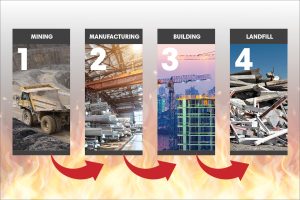
The traditional linear model for construction releases energy as CO2 at every stage of the material lifecycle.
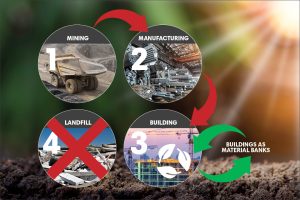
BAMB enables high‑value reuse rather than disposal, dramatically reducing the need for mining, processing, and manufacturing of new construction materials – activities that are among the most greenhouse‑gas‑intensive globally. This directly supports net‑zero targets while extending the life of high‑value materials and reducing land fill waste.
In addition, BAMB delivers economic benefits by lowering future construction costs through access to quality recovered materials, thereby offering a major economic incentive and a pathway toward net zero.
Initially implemented across three South Australian government pilot projects, the work has been strengthened by contributions from universities, media partners, and specialist consultancies who recognised its transformative potential. Born in South Australia yet designed for national and global adoption, this innovation could avoid 2,183 – 3,776 ktCO₂e annually in Australia, with exponentially greater impact if embraced worldwide.
How has this initiative been recognised in Australia?
The Green Building Council of Australia (GBCA) has recognised Kennett’s BAMB innovation, awarding it both a Market Transformation and a Leadership Challenge, with BAMB now integrated into Green Star pathways that reward circularity, contributing 4 Green Star points to an individual project.
In addition, BAMB was selected as a case study in the GBCA’s Procurement Framework Guidelines, developed with participation from three state governments (NSW, QLD & Vic), demonstrating national relevance and policy‑level engagement. View the case study on page 34 of A Practical Guide to Circular Procurement.
BAMB has received support from Green Industries SA’s Circular Economy and Market Development Grant (CBMDG) program to develop an Economic and Logistic Study to assess the broader value of BAMB. Preliminary findings indicate that BAMB delivers significant economic benefits alongside substantial greenhouse gas reductions. These benefits include the creation of new circular‑economy industries, increased employment, and greater productivity, achieving more economic output with fewer resources and less carbon. The study reinforces that BAMB is not only an environmental solution but also presents a major economic opportunity.
“As one of Australia’s leading sustainability consultants, we believe the BAMB initiative to be a genuine sea change in the construction industry’s approach to embodied carbon reduction in buildings. The BAMB initiative that has been implemented by Kennett proves that it is real, robust, and scalable, and we are excited to see its next stage of evolution. No other single initiative available in Australia makes such a meaningful, multi-generational impact.”
Paul Davy, Director dsquared Consulting.”
The University of Adelaide have undertaken foundation research to assess global BAMB initiatives and scalability as well as calculate potential emission reductions. Following a keynote presentation at Green Building Australia Day, numerous organisations across industry, academia, and government have sought further collaboration, demonstrating BAMB’s influence and its role in shaping the future of circular construction in SA.
Kennett’s General Manager, Anthony Carbone was interviewed on ABC Radio Adelaide upon the launch of Kennett’s BAMB initiative.
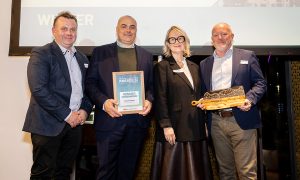
In August 2026 Kennett won the Business & Industry – Large Enterprise category at the bi-annual SA Climate Leaders Awards, an initiative of the Premiers Climate Change Council.
How can BAMB be implemented into my project?
The strategy is made available by Kennett not only to our own clients, but to any developer, builder, or government organisation wanting to participate in a more sustainable future – an industry‑wide leadership legacy for free.
To find out more about BAMB for your project, contact us here.